
A bakery chain needs 10,000 paper bags per day. A luxury boutique orders 5,000 premium handled bags with custom-printed designs. A cement plant asks for 50 kg valve sacks. These three customers represent completely different production requirements — and the paper bag machine that serves one will struggle with the others.
One of the most fundamental decisions in paper bag manufacturing is the feeding method: roll-fed or sheet-fed. This choice affects not only machine speed and material cost, but also the types of paper you can use, the bag styles you can produce, and the order sizes you can profitably accept.
This guide compares roll-fed and sheet-fed paper bag making solutions side by side. You will learn how each feeding method works, what production volumes they support, and which paper types they handle. By the end, you will have a practical decision framework to match your feeding method to your actual order pipeline — not the other way around.
Before comparing performance, it is essential to understand what each feeding method actually means on the production floor.
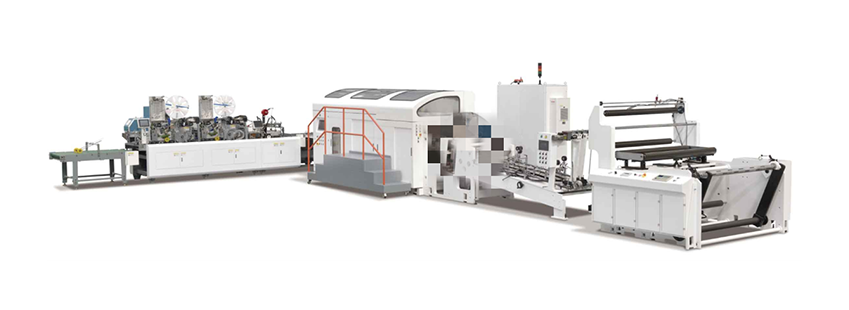
Roll-fed paper bag machines start with a continuous roll of paper — typically kraft paper, coated paper, or specialty paper wound onto a core. The machine unwinds the paper, feeds it through a series of forming stations, cuts it to length, folds the bottom, applies glue, and ejects the finished bag — all in a single continuous process.
Fangbang‘s roll-fed square bottom paper bag machine (ZD-FJ series), for example, is designed to manufacture square bottom paper bags without handles directly from a paper roll. It implements paper feeding, tube forming, tube cutting, and bottom forming in a single inline process.
Key characteristics of roll-fed production:
Continuous material feed — one roll can run for hours without interruption
Higher sustained speeds — up to 260 bags/min on standard models
Lower material waste once the line is running
Requires larger paper rolls (up to Ф1500mm diameter)
Limited to papers that can be wound onto rolls
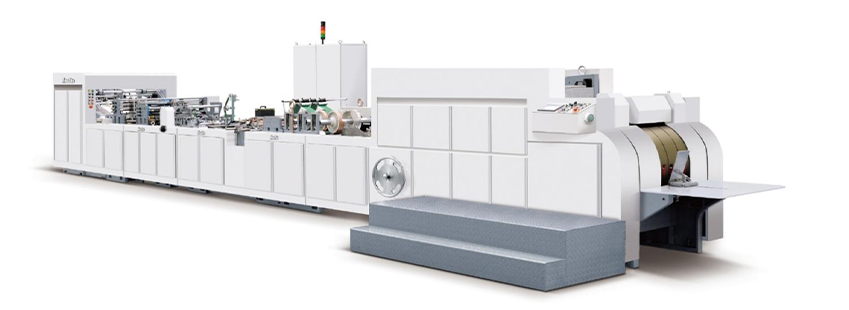
Sheet-fed paper bag machines start with pre-cut individual sheets of paper — stacked in a pile and fed one sheet at a time into the machine. Each sheet is processed through forming, folding, gluing, and bottom sealing stations to produce a finished bag in a single pass.
Fangbang‘s sheet-fed square bottom paper bag machine (ZD-FP series) uses a single sheet of high-quality kraft paper, art paper, or coated paper as raw material to produce durable, flat-bottomed square paper bags without handles in a single pass. The machine integrates automated paper feeding, precision tube forming, edge gluing, side pressing, and reinforced square bottom folding into one system.
Key characteristics of sheet-fed production:
Accepts pre-cut specialty papers that cannot be roll-fed
Slower sustained speeds — typically 80 bags/min
Higher setup flexibility between different paper types
Can process heavier paper stocks (up to 250 g/m²)
Ideal for short runs and frequent job changes
This is often the decisive factor for many packaging converters. The papers you plan to run determine which feeding method is even viable.
Roll-fed machines typically handle lighter paper stocks because the paper must withstand the tension of unwinding from a roll without tearing. Fangbang‘s roll-fed ZD-FJ series accommodates paper thickness from 45 to 170 g/m², depending on the specific model. The High-Speed Roll-fed model (ZD-FJ21+PE+S), for example, handles paper thickness of 80–170 g/m².
Sheet-fed machines, by contrast, can handle significantly heavier stocks because the paper is not subjected to winding tension. Fangbang‘s ZD-FP series accommodates paper thickness from 100 to 250 g/m². This makes sheet-fed the only viable option for coated art paper, laminated board, and heavy-duty specialty stocks that cannot be wound onto rolls.
Roll-fed machines are ideal for:
Standard kraft paper (45–130 g/m²)
Grease-proof paper
Coated paper (lighter grades)
Ribbed kraft paper
Medico paper
Sheet-fed machines can process:
The full range of roll-fed papers
Heavy coated art paper
Laminated cardboard (up to 250 g/m²)
Textured and specialty stocks
Paper with pre-printed designs that require precise registration
A key advantage of sheet-fed machines is their ability to handle paper with pre-printed designs that require precise fold registration. Because each sheet is fed individually, the machine can register folds and cuts to the printed image with greater accuracy than roll-fed systems running pre-printed rolls.
Roll-fed machines produce minimal waste once running — the continuous web means there are no gaps between sheets. However, setup waste can be significant: each roll change and size adjustment requires running several meters of paper through the machine to stabilize the process.
Sheet-fed machines have inherent waste between sheets (the gaps in the feed stack), but setup waste is generally lower because you can run a few test sheets without wasting an entire roll.
Speed differences between roll-fed and sheet-fed machines are substantial — and directly impact how many bags you can produce per shift.
Roll-fed machines are built for sustained high-speed production. Fangbang‘s ZD-FJ08 model achieves a maximum speed of 260 bags per minute. The ZD-FJ06 Fast Fixed-size model is designed for even higher throughput on small, standardized bags. The ZD-FJ11E model operates at 240 bags/min with a paper roll width up to 890mm.
At 260 bags/min, a roll-fed machine can produce over 15,000 bags per hour — or approximately 120,000 bags in a single 8-hour shift. This makes roll-fed the clear choice for high-volume, standardized orders where speed drives profitability.
Sheet-fed machines operate at more moderate speeds. Fangbang‘s ZD-FP series runs at a consistent 80 bags/min across all four models (ZD-FP08, ZD-FP14, ZD-FP18, ZD-FP20). The ZD-BFP model, a specialized sheet-fed machine with upper folding mouth and bottom card features, operates at 40–60 bags/min.
At 80 bags/min, a sheet-fed machine produces approximately 4,800 bags per hour — or about 38,000 bags in an 8-hour shift. This is roughly one-third the throughput of a comparable roll-fed machine.
| Feeding Method | Typical Speed | Bags per 8-hour shift | Best Suited For |
|---|---|---|---|
| Roll-fed (ZD-FJ08) | 260 bags/min | ~120,000 | High-volume, standardized orders |
| Roll-fed (ZD-FJ11E) | 240 bags/min | ~110,000 | Large-format bags |
| Sheet-fed (ZD-FP series) | 80 bags/min | ~38,000 | Short runs, specialty papers |
| Sheet-fed (ZD-BFP) | 40–60 bags/min | ~20,000–28,000 | Premium bags with folding mouth |
The speed difference is not a flaw of sheet-fed machines — it is a design trade-off. Sheet-fed machines prioritize flexibility and material compatibility over raw throughput. For a manufacturer running 10 different paper types across 50 different bag sizes per month, the ability to change jobs quickly may be more valuable than extra speed.
The total cost of ownership for roll-fed versus sheet-fed machines extends far beyond the initial equipment price.
Roll-fed machines generally offer lower material cost per bag because paper rolls are less expensive per unit area than pre-cut sheets. However, this advantage only materializes at high volumes — the setup waste and minimum roll order quantities from paper mills mean that small runs on roll-fed machines can actually be more expensive per bag than sheet-fed production.
Sheet-fed machines have higher material cost per sheet (because you are paying for cutting and handling), but they allow you to buy smaller quantities of specialty papers. For short runs of premium papers, sheet-fed can be more cost-effective overall.
Roll-fed machines require less operator intervention once running — the continuous web feed means fewer manual handling steps. This translates to lower labor cost per bag at high volumes.
Sheet-fed machines require more frequent operator attention — loading stacks of sheets, adjusting for different paper types, and managing the sheet feed mechanism. However, the labor cost difference narrows for short runs where setup time dominates.
Roll-fed machines are generally more expensive to purchase due to their more complex unwinding, tension control, and continuous feed systems. They also require more sophisticated maintenance — roll-fed systems have more moving parts, more wear points, and more precise alignment requirements.
Sheet-fed machines have simpler feed mechanisms, which can translate to lower purchase prices and simpler maintenance. The trade-off is lower speed and more frequent operator intervention.
A packaging manufacturer supplies 20 restaurant chains and e-commerce fulfillment centers. Monthly orders exceed 1 million square-bottom bags across 3 standard sizes. No handles. No printing. Paper is standard kraft at 70–100 g/m².
Recommendation: Roll-fed machine (ZD-FJ08 or ZD-FJ11E). The consistent volume, limited size variety, and standard paper type make roll-fed the most cost-effective choice. At 260 bags/min, one machine can handle the entire monthly volume in approximately 64 hours of runtime.
Key decision driver: Volume. When you are running millions of bags per month, every extra bag per minute translates directly to lower unit cost.
A small manufacturer serves 50 boutique shops and luxury brands. Monthly orders total 150,000 bags across 20 different sizes and 12 paper types. Orders require high-quality printing on coated art paper and laminated boards. Handles are required on about 40% of orders.
Recommendation: Sheet-fed machine (ZD-FP14 or ZD-FP18) as the primary line, with a separate roll-fed machine for high-volume standard orders if volume justifies it.
Key decision driver: Paper flexibility. The ZD-FP14 handles paper width up to 1050mm, and paper thickness up to 250 g/m² — covering coated art paper, textured stocks, and laminated boards that roll-fed machines cannot process. The ability to run 20 different bag sizes across 12 paper types without excessive setup waste makes sheet-fed the only viable option.
Many converters eventually operate both feeding methods. A roll-fed machine handles the high-volume, standard orders that provide steady cash flow. A sheet-fed machine handles the premium, custom, and short-run orders that deliver higher margins.
This hybrid approach allows you to:
Accept high-volume standard orders profitably (roll-fed)
Accept premium custom orders that competitors cannot handle (sheet-fed)
Cross-sell to customers who need both standard and premium bags
Maintain production continuity when one machine is down for maintenance
For a deeper understanding of how different machine configurations serve these market segments — and what production volumes each supports — explore the complete paper bag machine product lineup covering both roll-fed and sheet-fed models.
1. What paper weights do you run most often?
Under 130 g/m² → Roll-fed is viable
130–250 g/m² → Sheet-fed is required
Mixed range → Sheet-fed offers more flexibility
2. What is your average order quantity per SKU?
Over 100,000 bags → Roll-fed delivers lower unit cost
Under 50,000 bags → Sheet-fed may be more cost-effective
Mixed → Consider both or start with sheet-fed
3. How many different bag sizes do you produce per month?
Under 5 → Roll-fed setup time is manageable
Over 10 → Sheet-fed changeover advantages become significant
4. Do you use pre-printed paper with precise registration requirements?
Yes → Sheet-fed offers better registration accuracy
No → Roll-fed is sufficient
5. What is your primary market?
Food service, e-commerce, bulk retail → Roll-fed
Luxury retail, boutiques, gift packaging → Sheet-fed
Mixed → Hybrid approach
6. Do you need handles on most orders?
Yes → Both roll-fed and sheet-fed can accommodate handles (ZD-QFJ series for roll-fed, ZD-QFB for sheet-fed)
No → ZD-FJ (roll-fed) or ZD-FP (sheet-fed) are lower-cost options
7. What is your growth projection for the next 24 months?
Steady at current volume → Match machine to current needs
Rapid growth → Consider roll-fed for scalability
Diversifying into premium segments → Sheet-fed opens new markets
For practical answers to common questions about material compatibility, size adjustment flexibility, and machine maintenance across both feeding methods, review this technical FAQ on paper bag machine capabilities covering real-world operational considerations.
The paper packaging market continues to expand globally, driven by regulations reducing single-use plastics and increasing consumer preference for sustainable packaging. Within this growth, both roll-fed and sheet-fed segments are expanding — but driven by different demand factors.
Roll-fed demand is fueled by high-volume retail and e-commerce growth, where cost per bag and production speed are the primary competitive factors. Sheet-fed demand is driven by the premiumization of packaging — brands increasingly use high-quality paper bags as a marketing tool, requiring specialty papers and precise printing that only sheet-fed machines can deliver.
For a converter serving multiple industries, the choice is not binary. Many successful packaging manufacturers operate both feeding methods — using roll-fed for their main production line and sheet-fed for premium, short-run, and specialty orders. The decision is about matching machine capabilities to your specific customer order profile.
Once you have determined which feeding method aligns with your order profile — roll-fed for high-volume standard production, sheet-fed for premium specialty runs, or both for maximum flexibility — the next logical step is comparing specific machine specifications. Understanding how actual parameters (paper width range, speed, power requirements, overall dimensions) align with your facility constraints and order history will determine which specific model delivers the best return for your operation.
For a structured comparison across different machine configurations and their cost implications, read the guide “Square Bottom or V-Bottom Paper Bag Machine – Which Suits You?” — which analyzes how bottom shape interacts with feeding method to determine overall production economics.
Square Bottom or V-Bottom Paper Bag Machine – Which Suits You?
Which Paper Bag Making Solution Fits a Small Business?
5 Common Pain Points in Paper Bag Making Solution
Reduce Downtime with Smart Paper Bag Making Solution
From Roll to Bag: Understanding the Complete Paper Bag Making Process
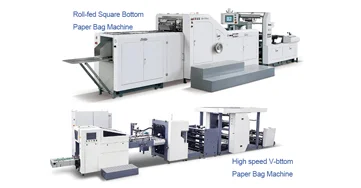
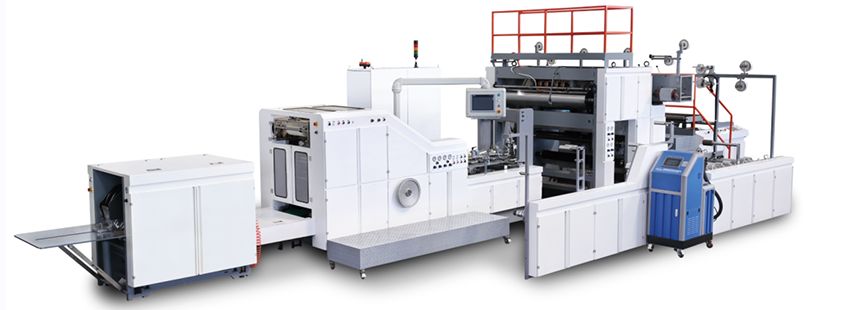
Full-Servo Automatic Square Bottom Paper Bag Making Machine for high-efficiency production of eco-friendly paper bags wi...
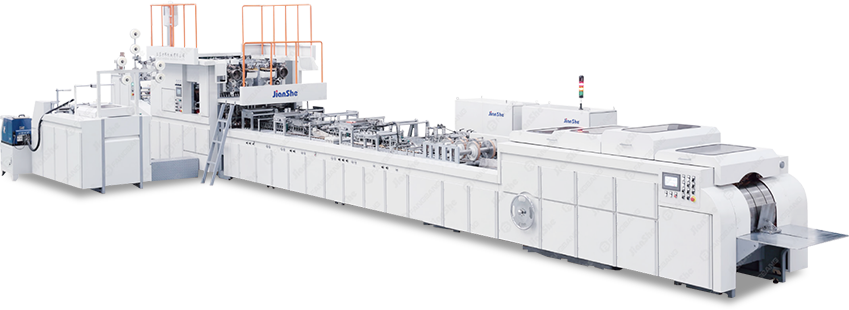
Fully Automatic Sheet-Fed Square Bottom Paper Bag Machine produces paper bags with handles at high speed. Uses sheet pap...
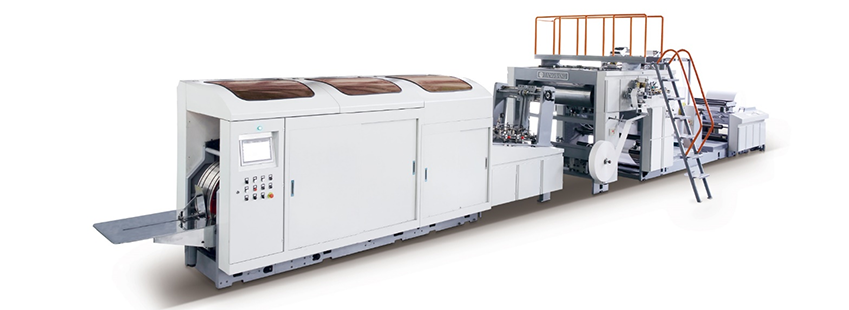
This machine is designed to manufacture square bottom paper bags with flat-rope handles from paper roll,paper patch roll...
GET A QUOTE




 中文
中文 English
 Español
 Français
 Pусский