
A bakery chain needs 300,000 lightweight bread bags per week. A supermarket requires 200,000 sturdy shopping bags that stand upright on shelves. The first order favors speed above all else. The second demands structural integrity over raw throughput.
The production speed gap between V-bottom and square bottom paper bag machines is substantial — up to 500 bags/min for high-speed V-bottom models versus 220–260 bags/min for square bottom counterparts. But speed alone does not determine which machine is right for your business. Material usage, bag strength, application fit, and total cost per bag all factor into the decision.
This guide compares high-speed V-bottom and square bottom paper bag machines side by side, using actual production data from Fangbang‘s ZD-J and ZD-FJ/ZD-QFJ series. You will learn how speed differences translate to real-world output, which applications each bottom type serves best, and how to match machine selection to your order profile.
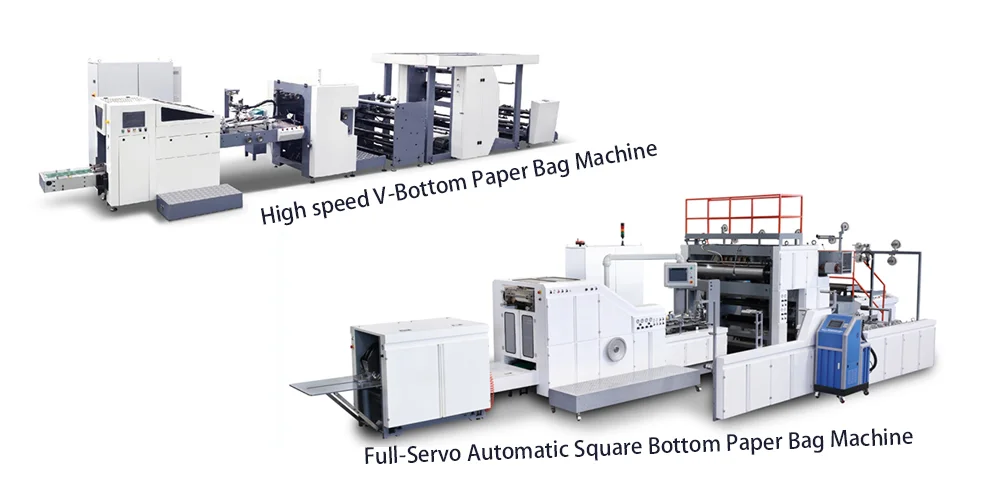
The most striking difference between V-bottom and square bottom machines is production speed. Fangbang’s High Speed V-bottom Paper Bag Machine (ZD-J series) reaches 500 bags/min, while the fastest square bottom models operate at roughly half that rate.
| Machine Type | Model | Max. Speed | Typical Application |
|---|---|---|---|
| V-Bottom | ZD-J13 | 500 bags/min | High-volume lightweight bags |
| V-Bottom | ZD-J10 | 320 bags/min | Medium-volume V-bottom bags |
| Square Bottom (Roll-Fed) | ZD-FJ08 | 260 bags/min | Standard no-handle square bottom bags |
| Square Bottom (Roll-Fed) | ZD-FJ05 | 200 bags/min | Small square bottom bags |
| Square Bottom (Roll-Fed) | ZD-FJ11E | 240 bags/min | Medium-large square bottom bags |
| Square Bottom (Roll-Fed) | ZD-FJ13E[S] | 220 bags/min | Large square bottom bags |
| Square Bottom (Sheet-Fed) | ZD-FP series | 80 bags/min | Premium specialty paper bags |
| Square Bottom (with Handles) | ZD-QFJ series | 110–220 bags/min | Handled retail shopping bags |
At 500 bags/min, a ZD-J13 V-bottom machine produces 30,000 bags per hour — or approximately 240,000 bags in an 8-hour shift. A ZD-FJ08 square bottom machine at 260 bags/min produces 15,600 bags per hour — approximately 124,800 bags per shift.
For a monthly order of 1 million bags:
V-bottom (ZD-J13): ~42 hours of runtime (just over 5 shifts)
Square bottom (ZD-FJ08): ~64 hours of runtime (8 shifts)
The V-bottom machine completes the same volume in roughly 35% less time — a significant advantage for high-volume, low-margin orders where production speed directly impacts profitability.
The speed gap is not arbitrary. It reflects fundamental differences in how each bottom type is formed.
V-bottom paper bag machines manufacture sharp bottom paper bags from a paper roll through a streamlined process: roll feeding, side gluing, perforating, tube forming, tube cutting, bottom folding and gluing, and finished bag collection — all within a fully automatic process. The pointed bottom requires fewer folding steps and less precision alignment than a square bottom, allowing the machine to run at significantly higher speeds. The ZD-J series is suitable for kraft paper, ribbed kraft paper, grease-proof paper, coated paper, and medico paper.
Key speed enablers:
French Schneider touchscreen human-machine interface for easy operation
UK TRIO PC micro-computer control system integrated with optical fiber for high-speed stability
Japanese Yaskawa Servo Control System and German SICK photocell for precise tracking
Square bottom paper bag machines require additional forming steps to create the flat, reinforced base that allows bags to stand upright. The ZD-FJ series, for example, implements paper feeding, tube forming, tube cutting, and bottom forming inline. The square bottom demands precise folding and gluing at multiple angles, which increases cycle time per bag.
The ZD-QFJ full-servo automatic square bottom paper bag machine with handles completes handle making, handle gluing, paper tube forming, paper tube cutting, and bag bottom forming in a single process. While this integration delivers fully automated production, the additional steps inherently limit top speed to 110–220 bags/min.
Speed is only one dimension. The right machine depends on what you are producing and for whom.
V-Bottom (ZD-J Series) – Best For:
Lightweight food packaging: snack bags, bread bags, pastry bags, dry fruit bags
High-volume, low-margin orders: where speed drives profitability
Products that do not require a flat base: items that will be carried or placed in containers
Bulk takeaway packaging: restaurants, bakeries, and fast-food chains
Specialty applications: grease-proof paper, coated paper, and medico paper packaging
The ZD-J13 handles paper thickness of 35–80 g/m², bag body length of 120–710mm, and bag body width of 80–320mm. Optional features include a window-making device with film unwinder and hot-melt glue system for transparent windows, as well as an optional printing unit.
Square Bottom (ZD-FJ / ZD-QFJ Series) – Best For:
Retail shopping bags: supermarkets, department stores, apparel brands
Bags that must stand upright on shelves: where presentation matters
Heavier loads: the flat base distributes weight evenly
Handled bags: ZD-QFJ series produces handled square bottom bags at 110–220 bags/min
Premium packaging: gift bags, boutique shopping bags, branded retail packaging
The ZD-FJ08 handles paper thickness of 45–130 g/m² with tube length of 190–370mm. The ZD-FJ11E handles paper roll width up to 890mm with tube length of 270–530mm. The ZD-FJ series can produce different bag bottoms, including diamond bottom, single (double) open square bottom, and options with thumbtacks.
For handled square bottom bags, the ZD-QFJ series offers versatile bag mouth cutting (toothed or flat shape) and dual-handle capability (both round rope and flat rope handles). For a detailed look at how the ZD-QFJ series achieves handle integration while maintaining square bottom quality, see the full-servo automatic square bottom paper bag machine configurations available in Fangbang’s product lineup.
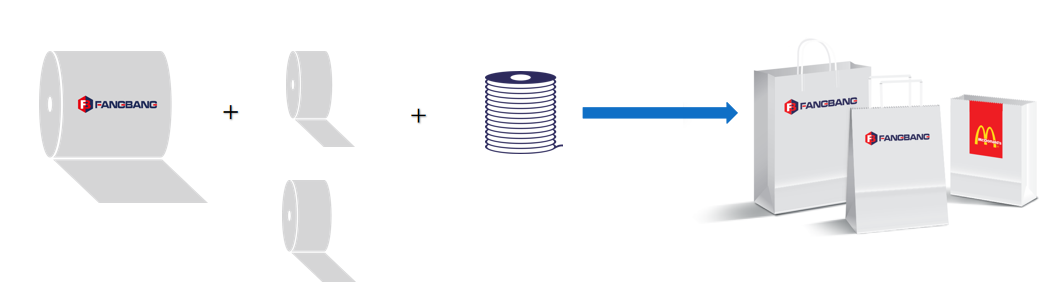
The speed advantage of V-bottom machines comes with trade-offs that affect total cost per bag.
| Cost Factor | V-Bottom (ZD-J13) | Square Bottom (ZD-FJ08) |
|---|---|---|
| Machine speed | 500 bags/min | 260 bags/min |
| Paper thickness range | 35–80 g/m² | 45–130 g/m² |
| Material usage | Lower (pointed bottom uses less paper) | Higher (flat base requires more material) |
| Bag strength | Moderate (pointed bottom) | Higher (reinforced flat base) |
| Labor cost per bag | Lower (higher throughput per operator) | Higher (more operator time per bag) |
| Machine complexity | Lower (simpler forming process) | Higher (more forming stations) |
| Maintenance | Lower (fewer moving parts) | Higher (more complex mechanics) |
| Total power | 21kw | 13.5kw |
The V-bottom machine’s higher speed translates to lower labor cost per bag — a single operator can produce significantly more bags per shift. However, the square bottom machine produces a stronger, more premium bag that commands higher prices in retail markets.
Scenario: Monthly production of 500,000 bags
| V-Bottom (ZD-J13) | Square Bottom (ZD-FJ08) | |
|---|---|---|
| Runtime at max speed | ~16.7 hours | ~32 hours |
| Labor cost (assuming 1 operator) | Lower | Higher |
| Material cost per bag | Lower (35–80 g/m²) | Higher (45–130 g/m²) |
| Revenue per bag | Lower (commodity market) | Higher (premium retail market) |
The V-bottom machine delivers a lower cost per bag for high-volume commodity orders. The square bottom machine delivers a higher margin per bag for premium retail applications where customers pay for quality and presentation.
A packaging manufacturer supplies bread and pastry bags to 50 bakeries across three states. Monthly orders exceed 1.5 million bags. Bags are lightweight (55–70 g/m² paper), require no handles, and are used for takeaway service. Customers prioritize low cost and consistent supply over premium presentation.
Recommended configuration: ZD-J13 high-speed V-bottom machine.
Speed: 500 bags/min — 1.5 million bags completed in ~50 hours of runtime
Paper thickness: 35–80 g/m² — covers standard bakery bag stock
Bag size: up to 710mm length × 320mm width
Material: kraft paper, grease-proof paper, or coated paper
Optional: printing unit for brand logos
Why this works: The bakery bag market is volume-driven. Speed and material efficiency determine profitability. The V-bottom’s 500 bags/min output and lower paper consumption (35–80 g/m²) deliver the lowest cost per bag.
A packaging converter supplies shopping bags to 20 supermarket chains. Monthly orders: 800,000 square bottom bags without handles, across 4 standard sizes. Bags must stand upright on shelves, carry 4–6 kg of groceries, and project a professional appearance.
Recommended configuration: ZD-FJ08 or ZD-FJ11E roll-fed square bottom machine.
Speed: 260 bags/min (ZD-FJ08) — 800,000 bags completed in ~51 hours
Paper thickness: 45–130 g/m² (ZD-FJ08)
Tube length: 190–370mm (ZD-FJ08)
Bag body width: 80–200mm (ZD-FJ08)
Quick size change: adjustable double template structure reduces changeover time
Why this works: Supermarket bags require the durability and stability of square bottom construction. The flat base is essential for shelf presentation and load-bearing. While slower than V-bottom, the ZD-FJ08’s 260 bags/min is sufficient for this volume, and the higher-value retail market justifies the additional material cost.
A boutique packaging company produces 150,000 handled gift bags monthly for luxury retailers. Bags require handles, high-quality printing on coated paper, and a premium square bottom finish.
Recommended configuration: ZD-QFJ series full-servo square bottom machine with handles.
Speed: 110–220 bags/min (depending on model)
Handle types: round rope or flat rope
Paper thickness: 45–140 g/m²
Paper roll width: 370–1530mm
Versatile cutting: toothed or flat bag mouth shapes
Why this works: Handled gift bags command premium prices that justify the lower speed of square bottom production. The ZD-QFJ’s ability to produce both round and flat rope handles, combined with its full-servo precision, delivers the quality required for luxury retail applications.
Use these questions to guide your decision:
Food service, bulk takeaway → V-bottom (ZD-J series)
Retail, supermarkets, premium brands → Square bottom (ZD-FJ or ZD-QFJ series)
Over 1 million bags per month → V-bottom speed advantage becomes critical
Under 500,000 bags per month → Square bottom speed may be sufficient
35–80 g/m² (lightweight) → V-bottom
45–170 g/m² (standard to heavy) → Square bottom
Yes → Square bottom with handles (ZD-QFJ series)
No → Either type possible
Yes (retail display) → Square bottom
No (takeaway, delivery) → V-bottom
Low margin, high volume → V-bottom (lower cost per bag)
Higher margin, premium positioning → Square bottom (higher perceived value)
Both V-bottom and square bottom paper bag machines serve growing markets, but demand drivers differ.
V-bottom demand is fueled by the food service and takeaway sector — bakeries, fast-food chains, coffee shops, and specialty food retailers. The lightweight, high-speed nature of V-bottom production aligns with the volume and cost pressures of this market. Optional features such as window-making devices and printing units allow V-bottom machines to handle branded takeaway packaging without sacrificing speed.
Square bottom demand is driven by retail and e-commerce growth, where packaging serves as brand communication. The ability to stand upright on shelves, carry heavier loads, and present a premium appearance makes square bottom the standard for shopping bags, gift bags, and branded retail packaging.
Many packaging converters eventually operate both machine types — V-bottom for high-volume food service orders and square bottom for premium retail applications. The choice is not about which is “better,” but about which machine fits your specific order profile.
Once you have determined which speed profile and bottom type align with your order volume and market position — V-bottom for high-speed, lightweight production, or square bottom for stable, premium retail bags — the next logical step is comparing specific machine specifications. Understanding how actual parameters (paper thickness range, bag size capacity, power requirements, and optional features) align with your production requirements will determine which specific model delivers the best return for your operation.
The following guides explore specific aspects of the V-bottom vs square bottom decision in greater depth:
Understanding the Speed Advantage: When 500 Bags/Min Changes Your Business Model
Square Bottom Bag Strength: Why Retail Customers Pay More for Stability
From V-Bottom to Square Bottom: How to Decide When Your Order Mix Shifts
V-Bottom Machine Optional Features: Window-Making and Printing Units Explained
Square Bottom Machine Changeover Time: How Adjustable Templates Reduce Downtime
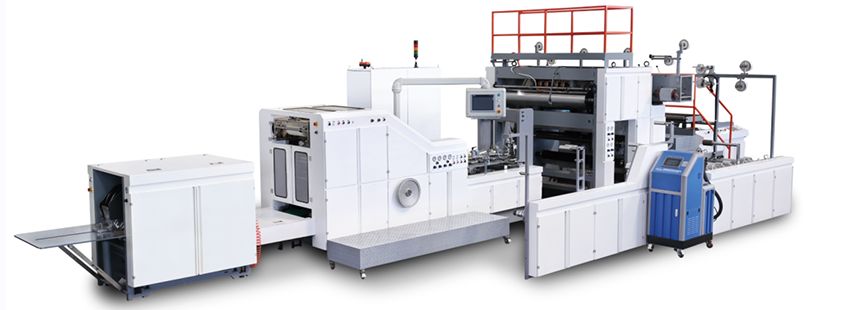
Full-Servo Automatic Square Bottom Paper Bag Making Machine for high-efficiency production of eco-friendly paper bags wi...
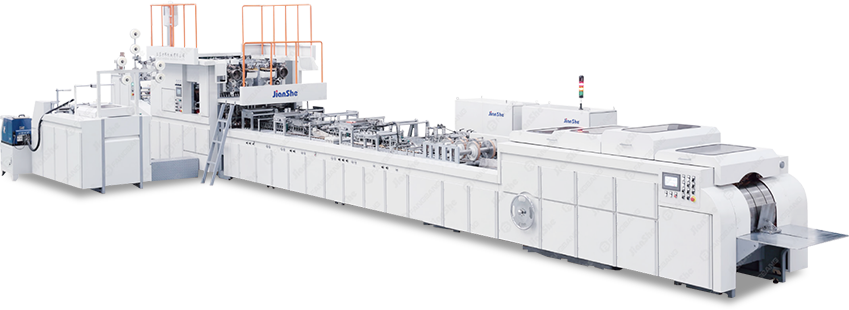
Fully Automatic Sheet-Fed Square Bottom Paper Bag Machine produces paper bags with handles at high speed. Uses sheet pap...
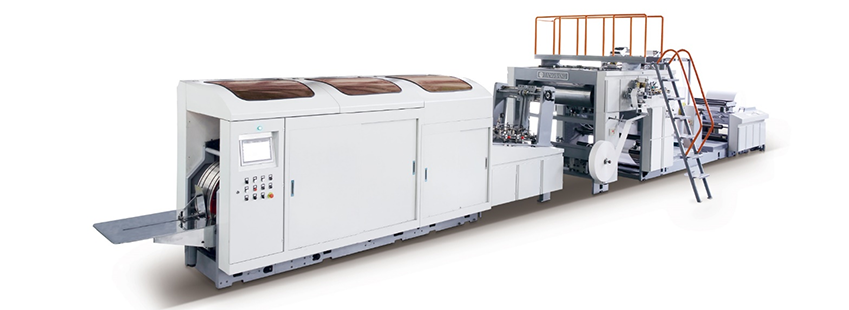
This machine is designed to manufacture square bottom paper bags with flat-rope handles from paper roll,paper patch roll...
GET A QUOTE




 中文
中文 English
 Español
 Français
 Pусский