Roll-Fed vs Sheet-Fed Paper Bag Machine – Which to Choose?
Time:2026 / 05 / 19
Posted By: Peter
When you run a packaging business, selecting the right converting equipment can feel like standing at a fork in the road. Do you invest in a system that unrolls paper from a jumbo roll, or one that feeds pre-cut sheets one by one? Both approaches produce paper bags, yet the workflow, output quality, and operational costs differ significantly. This guide breaks down the real-world trade-offs between roll-fed and sheet-fed bag-making machines, using actual production data from commercially available equipment — not marketing claims. You'll learn which technology aligns with your order volume, bag design complexity, and floor space.
Understanding the Core Difference
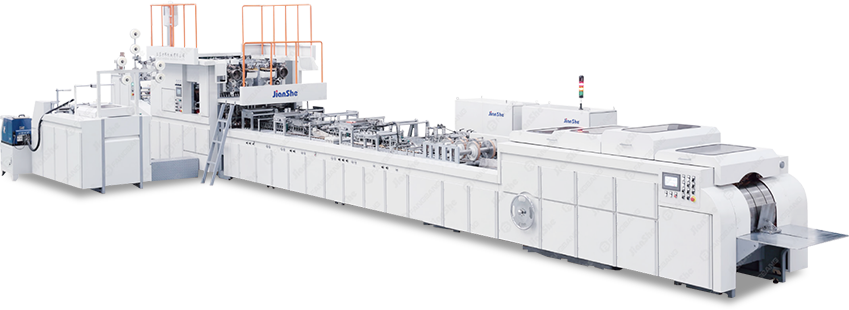
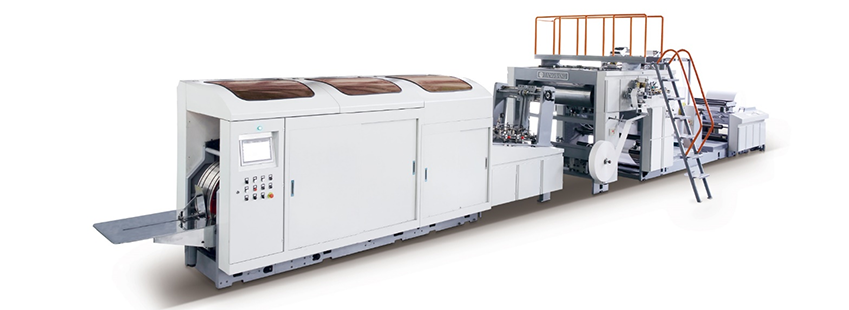
The fundamental distinction lies in how paper enters the machine. Roll-fed units take a large parent roll — typically up to 1,700 mm wide, weighing several hundred kilograms — and continuously unwind, fold, glue, and cut bags in one seamless line. Think of it as a high-speed assembly line that never stops. Sheet-fed machines, on the other hand, process individual pre-cut sheets — each sheet becomes one bag. This is closer to a batch process where precision matters more than raw speed.
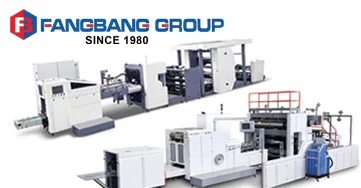
For manufacturers handling large retail orders, the roll-fed approach dominates. For specialty bags with unique prints, reinforced bottoms, or short runs, sheet-fed offers more control. Want to check live production footage of both systems running? Seeing the continuous flow side by side helps clarify which rhythm fits your floor.
Key Comparison Dimensions
1. Production Speed & Volume
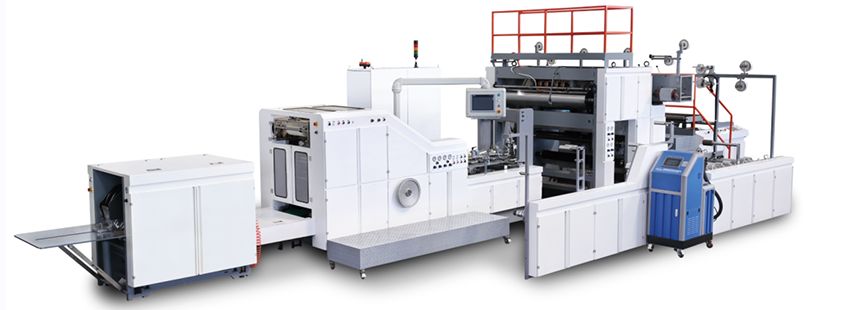
Roll-fed systems are built for continuous, high-volume output. FangBang's ZD-FJ06 roll-fed square-bottom paper bag machine achieves up to 260 bags per minute — one of the fastest in its class for handleless square-bottom bags. Once the roll is loaded, the operation runs automatically until the roll depletes. This makes it ideal for standard brown bags, SOS bags, or block-bottom bags in large quantities.
For bag styles requiring handles, FangBang's full-servo roll-fed models run at 110–220 bags/min. Dual-layer configurations maintain 150 bags/min while handling paper roll widths from 770 mm to 1,700 mm — giving you the flexibility to process both single-layer and double-layer square bottom bags on the same footprint.
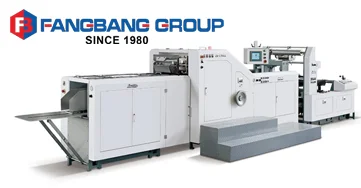
Sheet-fed machines operate more slowly — typically 40–60 bags per minute for models like FangBang's ZD-BFP series — because each sheet must be aligned, fed, folded, and glued individually. However, this slower pace allows for intricate bottom reinforcements that are difficult to achieve on a roll-fed line.
Verdict: If your monthly volume exceeds 1 million bags, roll-fed is the clear winner. For smaller shops or custom packaging studios producing high-end handbags, sheet-fed's lower minimum order quantity and handle versatility are more practical.
2. Material Flexibility & Waste
Roll-fed machines require paper that is consistently wound, with uniform tension and no splices. FangBang roll-fed models accommodate paper thickness from 55 gsm up to 170 gsm, depending on configuration: the ultra-fast ZD-J model handles 55–70 gsm for lightweight applications, while ZD-FJ22+D processes 80–170 gsm for heavier e-commerce shipping bags. The maximum paper roll diameter reaches 1,500 mm. Waste occurs mainly during roll changes and setup.
Sheet-fed machines can handle a wider range — up to 250 gsm on compatible models — and accommodate paper lengths from 310 mm to 630 mm, with paper width from 400 mm to 1,320 mm. Since you load precut sheets, you can also use offcuts or sheets from different batches. According to industry data, modern roll-fed systems with servo drives achieve waste rates of 2–4%, while manual sheet-fed lines run 6–10% waste from misaligned sheets and double feeds.
One Midwest converter reported that switching from sheet-fed to roll-fed reduced his monthly paper waste from 12 metric tons to under 4 tons — at a paper cost of 1,100perton,that′snearly1,100perton,that′snearly9,000 monthly savings.
For applications requiring tight registration and complex bottom forming, FangBang's sheet-fed machines feature photoelectric eye technology that automatically corrects cutting length and ensures square bottom length accuracy within ±1 mm.
3. Print Registration & Bag Complexity
This is where sheet-fed often wins. Because each sheet is stationary when printed (or when using pre-printed sheets), registration can be extremely precise. FangBang's sheet-fed machines are built with Grade 5–6 machining accuracy and a five-way one-piece moulding design, with castings aged for no less than 10 months to ensure permanent shaping. This matters for bags with brand logos, barcodes, or multi-color designs that must align perfectly on the bag's front, back, and gussets.
Roll-fed machines can also print inline (using flexo units), but the continuous web introduces tension variation. That said, FangBang's roll-fed platform supports additional embedded functional units — flexo printing, dual-layer pasting, die-cut window making, patching, and punching — between the unwinding unit and tube forming unit, allowing you to build a customized production line without losing speed.
For high-end retail or promotional bags, sheet-fed gives better consistency. For simple one- or two-color prints on large volumes, roll-fed is more cost-effective.
4. Labor & Skill Requirements
A modern roll-fed machine requires one operator to monitor the roll stand, glue application, and stacking section. Once running, the operator can handle multiple machines. FangBang's roll-fed systems feature symmetrical adjustable double template structures — operators do not need to change templates for different bag sizes, dramatically reducing adjustment time.
Sheet-fed machines need more hands-on attention: loading sheets, clearing mis-feeds, and adjusting alignment for each batch. However, FangBang has integrated intelligent control technology into its sheet-fed platform: when changing products, machine parameters can be adjusted quickly and accurately via the control interface to meet different production requirements. For short runs, this is manageable. For long runs, the constant reloading becomes tedious.
5. Initial Investment & ROI
Factor
Roll-Fed (FangBang ZD-FJ06)
Sheet-Fed (FangBang ZD-BFP)
Max. production speed
260 bags/min
40–60 bags/min
Paper thickness range
55–170 gsm
Up to 250 gsm
Bag size range
Tube length 130–770mm
Paper length 310–630 mm/width 400–1320mm
Material waste (typical)
2–4%
6–10%
Investment range (new)
20,000–20,000–200,000+
15,000–15,000–70,000
Changeover time
12–18 min
25–40 min
Typical payback period
6–18 months
12–24 months
Estimates based on industry averages (2023–2025) and FangBang published specifications. Actual figures depend on configuration, local labor rates, and order volume.
For applications requiring registration accuracy within ±1mm, FangBang's sheet-fed line offers higher precision at a lower entry cost. The trade-off is per-bag labor cost and slower throughput.
Which One Should You Choose?
There's no universal "best" — only the best fit for your order profile.
Go with a roll-fed system if:
You produce plain or basic printed bags in quantities of over 500,000 units per run.
Your paper weight stays within 55–170 gsm.
You have continuous orders from supermarkets, fast-food chains, or e-commerce fulfillment centers.
You can dedicate floor space and want minimal operator intervention after setup.
Go with a sheet-fed system if:
Your average batch size is under 50,000 bags.
You handle thick paper, recycled board, or specialty materials.
Each bag requires fine print registration or custom bottom reinforcements.
You're starting and want a lower upfront investment, or plan to offer many bag styles with handles.
Many mid-size packaging companies actually keep both types: a roll-fed line for their staple brown bags and a sheet-fed line for premium custom orders. That hybrid approach allows them to say "yes" to almost any customer request without overcommitting inventory.
Making Your Decision Data-Driven
Before purchasing any equipment, run a simple test: collect your last 20 orders and calculate the average quantity, paper type, and print requirement. Then ask potential suppliers to produce sample bags on both technologies. Pay attention to:
Bag strength (bottom seal and side gusset integrity)
Print sharpness (especially on recycled paper)
Set up time between different bag sizes
Also, check relevant industry standards: while ISO 12625 primarily addresses tissue paper testing, the same principles apply to bag paper quality assessment. For packaging-grade kraft, TAPPI standards provide additional testing frameworks. Reputable manufacturers will provide test reports or allow on-site demonstrations. FangBang's technical team offers a free "bag sample test" — you send them your paper stock and bag design, and they'll run it on both platforms to show you actual output quality and cycle times.
Where to Find Reliable Equipment
If you are evaluating suppliers, consider companies that specialize in both feeding technologies. A manufacturer with deep experience in roll-fed and sheet-fed systems can offer unbiased guidance based on your actual bag samples.
FangBang has engineered papbag-making machinery for over a decade, serving converters across Southeast Asia, the Middle East, and Africa. Their roll-fed portfolio includes:
ZD-FJ06: Up to 500 bags/min, tube length 380 mm, for fast fixed-size production
ZD-FJ series (Dual-Layer): Up to 150 bags/min, paper roll width 770–1,700 mm
ZD-QFB (Full-Servo): 110–220 bags/min with handle compatibility
Their sheet-fed lineup features:
ZD-BFP (Sheet-Fed Square Bottom): Paper length 310–630 mm, width 390–1,320 mm
ZD-FP (Automatic Sheet-Fed with Handles): Processes sheet paper, patch rolls, and rope for premium packaging
Intelligent control technology with ±1 mm cutting accuracy, supported by Grade 5–6 machining and 10-month aged castings for permanent dimensional stability.
The roll-fed versus sheet-fed debate isn't about which technology is "newer" or "more advanced." It's about aligning your machine's workflow with your customers' ordering patterns. A mismatch will either tie up capital in unneeded speed or create bottlenecks from slow throughput. By honestly mapping your volume, material range, and print requirements to the five dimensions above — using actual data from machines like FangBang's ZD-FJ06 (roll-fed) and ZD-BFP (sheet-fed) — you'll make a choice that serves your business for the next five to ten years.





 中文
中文 English
 Español
 Français
 Pусский